
overlays in clay
Self-sustained cultivation pavilion using robotic fabrication
Summer Studio | 2022
University of Pennsylvania
Location : Philadelphia, PA
Instructor: Nate Hume
In collaboration with Tianyi Yin
This project reimagines the wall section as an inhabitable, multifunctional space, blurring the boundary between interior and exterior, offering a contemporary take on “nature within space” and redefining the architectural role of the wall.
The design scope investigates the intersection of material behavior, environmental performance, and digital fabrication. The aim was to develop a modular wall system using clay extrusion and robotic arm, responsive to passive climate strategies and ecological site conditions. Design of the wall system is synthesized across multiple scales from shingles to structural systems.
Redrawing Louis Kahn Castle Plans
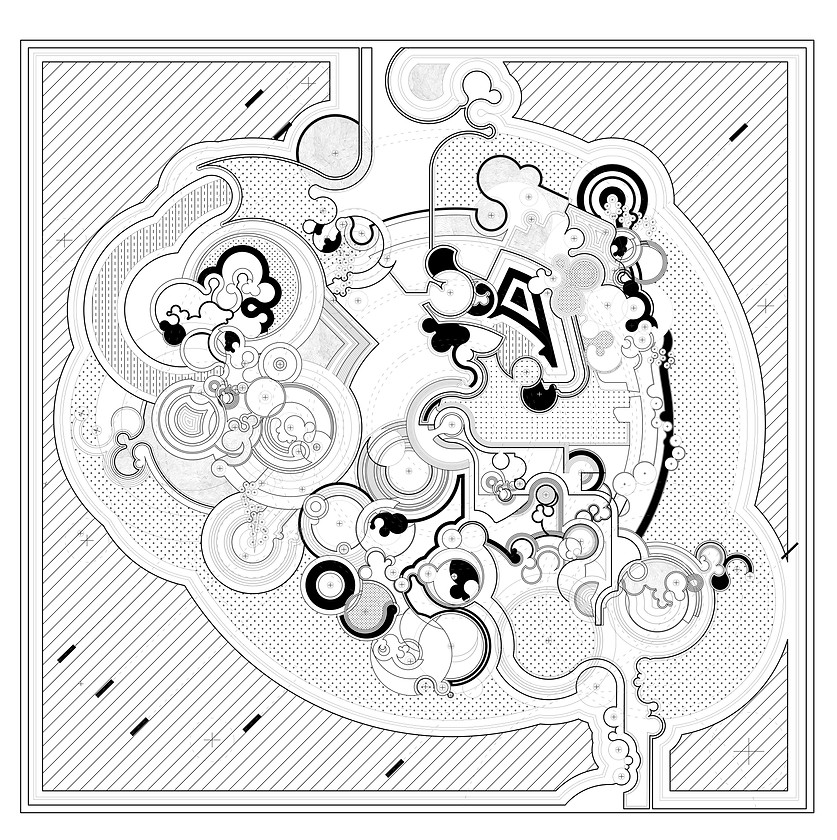
//Redrawn Castle Plan


//Poshe redrawn (Above); Intersections (Bottom Left); New Figure ground mapping (Bottom Right)
Tangents from Kahn’s original plan generate folded, nested geometries that dissolve the traditional poche. The resulting figure-ground blurs boundaries, transforming the castle into a spatial labyrinth with potential for organic shingle profiles.

//Physical Model
Research intent
Shingles tumble and overlap, creating a layered & shifting surface. This study informed the clay mass optimization for thermal buffering and natural cooling. Further, vegetation is integrated according to their sunlight requirements
aligning with shingles’ directional shifts. Together, the composition balances intentional disorder with micro-level order through the interaction of material and growth.
Mock-up Fabrication
Structure design
The weight of shingles is counter-balanced by timber joists that are connected to the main structure by lap joint joinery. A steel tubular section connects the shingle to the end effector for controlled rotation. The design is suitable for off-site fabrication and can be assembled with low-tech tools.

//Pavillion chunk
Shingle design
Ceramic shingles were 3D printed using a seven-axis robotic arm programmed with a Grasshopper script. A mock-up was built with dimensional lumber, using 3D-printed PLA joints to allow controlled rotation along all three axes and test the intended tumbling effect of the facade system.


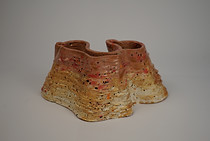


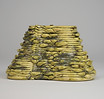


Inspired by the growth patterns of wildflowers, the facade uses organically profiled ceramic shingles to create multi-scalar visual movement. Shingles are rotated at 30°, 45°, and 60° along the X and Y axes to generate a controlled tumbling effect through subtle variation. Several design and fabrication cycles tested the limits of ceramic 3D printing. Following a previous iteration, tolerances were increased to accommodate clay shrinkage during kiln firing.
//Texture design process (Above); Fabricated Shingles (Bottom)

Mock-up Assembly

//Mock-up elements- exploded diagram (Above); Mechanical end-effector conditions (Bottom Left)

Fruit Pavillion


//Pavillion Unfolding (Above); Pavillion Chunk (Below)
Schematic Wall Section

Stuffed Wall Envelope
The vegetation systems are embedded within a layered, coffer-like wall structure. Planting pockets are integrated in various capacities to support native growth and microclimate regulation. Inhabitable spaces of varying scales are interwoven throughout, allowing visitors to engage with the vegetation system at different stages of growth and dissolving boundaries between interior and exterior.

Vegetation Technology System

Fruit Pavilion: Vegetation systems integration
The vegetation system proposed is two-fold: the primary system is embedded in shingle assemblies, where plants grow in vacuum-sealed chambers with intermittent misting for nutrients and water. This system improves insulation via planted mass and passive humidification. A secondary system supports shade-tolerant species like grapevines and strawberries, integrated into the wall section and structural niches that are modular and scalable to form canopies over habitable spaces and shape the interior microclimate and spatial experience.
